
Enterprise digital marketing is a different beast. Anyone who’s tried to implement a new content strategy, update a technical SEO framework, or roll out a new analytics stack across a large organization knows this viscerally. What takes a small business a week takes an enterprise a quarter — and that’s if the stakeholder alignment goes smoothly.
So when a new strategic discipline like AIEO emerges, the enterprise question isn’t just “what is it” — it’s “how do we actually operationalize this at scale, across multiple business units, multiple geographies, multiple content teams, and multiple technical stacks?” That’s the real challenge. And it’s a meaningful one.
Why Enterprise AI Visibility Is Uniquely Complex
Small businesses optimizing for AI visibility face a relatively contained problem. One brand, one website, one content team, one target audience. You can implement entity optimization, deepen your content, build behavioral signals, and monitor results without navigating a complex organizational matrix.
Enterprises face the same underlying challenge but multiplied across vectors that don’t multiply cleanly. A global enterprise might have dozens of regional websites, hundreds of product lines, multiple brand architectures, content teams in different time zones operating with different tools and processes, and stakeholders in marketing, IT, legal, and communications who all need to be aligned on any strategic shift.
Add to this the fact that enterprise brands often have significant existing digital infrastructure — legacy content management systems, established technical SEO programs, long-standing backlink profiles — and the AIEO implementation question becomes genuinely complex. You’re not building from scratch. You’re integrating into an existing, often complicated, ecosystem.
The Core Components of Enterprise AIEO
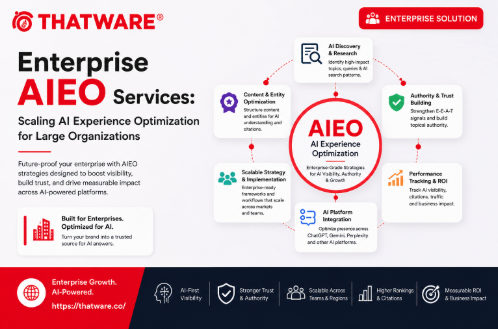
Enterprise AIEO services at the organizational level address several dimensions that don’t exist at a smaller scale.
Brand Architecture and Entity Mapping — Large organizations typically have multiple brands, sub-brands, product lines, and business units. Each of these may need distinct entity optimization strategies, while maintaining coherent relationships within the parent brand architecture. AI systems need to understand not just who the parent company is, but how its various brands relate to each other and to their respective topic domains. Getting this entity architecture right is a foundational enterprise AIEO challenge.
Content Governance and Scaling — Enterprise AIEO requires a level of content consistency and quality that demands governance infrastructure. This means developing clear content standards that align with AIEO requirements, training content teams across the organization, and building editorial processes that ensure new content consistently meets the depth, structure, and accuracy standards that AI systems evaluate favorably. Doing this across dozens of content teams requires systematic investment, not just guidelines.
Technical Infrastructure at Scale — Schema markup, structured data, and the technical architecture that enables AI comprehension needs to be implemented across potentially thousands of pages and multiple technical platforms. This requires coordination between SEO, development, and content teams, often across different CMS environments and technical stacks. Enterprise AIEO implementation typically requires a phased technical rollout with clear prioritization frameworks.
Multi-Geography Considerations — Global enterprises operating across multiple languages and regions face additional complexity. Entity optimization needs to account for local knowledge graph variations. Content depth requirements apply across language variants. AI system preferences may differ subtly by geographic market. Building AIEO capabilities that work across global operations requires language-specific expertise and localized implementation.
Building the Internal AIEO Capability
One of the critical decisions enterprises face is the build-versus-buy question: develop internal AIEO capabilities or partner with external specialists?
The honest answer, for most enterprises, is both. A pure DIY approach typically fails because AIEO requires specialized expertise that most organizations don’t have internally — particularly around LLM citation dynamics, entity optimization, and AI-specific content strategy. Pure outsourcing fails because sustainable AIEO results require internal teams who understand the organization’s brand, products, and audiences well enough to execute strategy with depth and consistency.
The most effective enterprise AIEO programs tend to follow a model where external specialists provide the strategic framework, technical expertise, and ongoing optimization guidance, while internal teams are trained and equipped to execute content strategy and maintain brand architecture standards.
AIEO optimization services at the enterprise level also require robust reporting infrastructure. Leadership teams need to understand AI visibility performance in terms that connect to business outcomes — brand awareness metrics, qualified traffic trends, AI-influenced pipeline contribution. Building this reporting framework early, before it’s urgently needed, is one of the smarter investments an enterprise can make in its AIEO program.
Stakeholder Alignment: The Underrated Challenge
Technical and content challenges get most of the attention in enterprise AIEO discussions. Stakeholder alignment often gets less — but it’s frequently the deciding factor in whether an implementation succeeds.
AIEO touches multiple organizational functions. SEO teams, content teams, PR and communications, IT and development, legal (especially in regulated industries), and senior marketing leadership all have stakes in how AI visibility strategy is developed and executed. Getting alignment across these groups requires a business case that speaks each function’s language.
For SEO teams: AIEO doesn’t replace your work — it extends and amplifies it. For content teams: AIEO isn’t more work for its own sake — it’s a framework for producing content that performs better across all channels. For IT: the technical requirements are specific but not radical — they build on existing schema and structured data investments. For legal: AI visibility creates the same brand safety considerations as other digital marketing channels, and the same governance frameworks apply.
Building this multi-stakeholder case early, before implementation begins, saves enormous friction later.
Phased Implementation at Enterprise Scale
Given the complexity, enterprise AIEO almost always needs to be phased. A reasonable approach:
Phase 1 — Audit and Architecture (Months 1-3): Comprehensive AI visibility audit across all brands and business units. Entity architecture mapping. Technical audit and prioritization. Governance framework development. Stakeholder alignment and internal training.
Phase 2 — Foundation Building (Months 3-9): Entity optimization rollout starting with primary brand and highest-priority business units. Technical schema implementation across priority properties. Content standards deployment and training for content teams. Initial authority signal development through PR and strategic citation building.
Phase 3 — Scaling and Optimization (Months 9+): Rollout across remaining business units and geographies. Ongoing content deepening and behavioral signal development. AI visibility monitoring and reporting. Iterative optimization based on performance data.
The Competitive Dimension
One thing enterprise brands tend to underestimate: their size is an asset in AIEO, if they move early. Large organizations have content resources, domain authority, brand recognition, and media relationships that create natural AIEO advantages — but only if those advantages are deliberately channeled into the right infrastructure.
A well-resourced enterprise that commits to AIEO seriously can build a level of AI visibility that smaller competitors will struggle to replicate for years. That window of competitive advantage exists right now. Enterprises that invest in comprehensive AIEO strategy in 2026 will have a structural advantage as AI-mediated search continues to grow.
The complexity is real. But so is the opportunity.
